She was making too much noise

Standard

Karachi
She goes to school on a wheel chair. Because two men on a motorbike shot her father dead; when she screamed they shot her thrice. She was making too much noise. That’s what the killers confessed to the police.
The men belonged to a banned militant outfit. They wanted Pakistan to be a Sunni state—their kind of a Sunni state.
Mehzar is 14 now. She has a hole in her neck—it goes right through her throat—the skin has covered it now but the scar remains. It reminds her of the 40 days she spent on a ventilator, she breathed through an oxygen mask, and ate food through a tube inserted in her neck.
When she gained consciousness she asked everyone where her father was. Everyone told her that her father was very sick. But she knew they were lying. She had watched her father die—and then she had fainted.

mehzar
In November 2012, Syed Nazar Abbasi and Syeda Mehzar, father and daughter were heading to school, when two men on a motorbike opened fire at Shaheed-e-Millat Road. Nazar died, Mehzar survived.
Two years and several surgeries later, Mehzar is confined to a wheelchair. Doctors say that her legs have twisted to an awkward angle and she might never be able to walk again.
Her mother refuses to believe them. “My Maula makes miracles happen.” That’s what she said to the doctors when Mehzar was fighting for her life on a ventilator. The doctors had given up. But this mother insisted a miracle was around the corner.
As compensation the family received Rs5000,000. Out of that Rs200,000 went for the initial surgery and treatment. After three months Mehzar was allowed to go home but only if she continued getting regular physiotherapy. That took away Rs70,000 a month.
When the compensation money drained out the family took her to a cheaper physiotherapist. But he spoilt the position of her legs.
Sometimes she gets bed sores. The last time she got one, she was sick with fever for a whole month. Her kidneys give problems too. Doctors recommend her to drink lots of water.
And then there is the trauma. For a year she missed out school. She would scream and get very angry. Her family took her for psychotherapy. She still gets very angry. And scared when men on motorbikes get near her car.
“Did you ever think I would be confined to a wheelchair like this?,” she asked her aunt at a family wedding. That was the only time she ever talked about the incident in two years.

Syed Nazar, her father

Syed Nazar, her father

“She doesn’t talk about the incident. Or her father, but I know she misses him very much,” says her mother.
Mehzar started school last year. She is preparing for her grade nine exams. When she takes a break from studies she watches television. There was snowfall in Murree, says the news bulletin. She oohs and aahs. “I want to see the snowfall too,” she laughs.
When she gets older she wants to design houses. Paint colours. Bright colours—blues, reds, yellows.

A family photo taken while Mehzar was still getting treated at the hospital

A family photo taken while Mehzar was still getting treated at the hospital

The family shifted to a new apartment. The old one did not feel safe. They sold off most of their furniture. This house is too small, they say.
Their toilet seat broke today. “Thank God Mehzar was not sitting on it,” says her mother. “It is hard for me to pick her now. My back hurts. Don’t tell her. She gets very angry.”
Life for them will never be the same. It is slipping out of their hands. They want to leave the city, and the country— it has too many painful memories.
And what has Mehzar got to say. “Nothing,” she shrugs, and buries herself in her books. There is no time to mourn.

As I write Mehzar’s story another blast has ripped through a Bohri Masjid in Karachi’s crowded Saddar. Two people died, and several are reported injured. I dread to think that they will go through the same fate Mehzar did. For this is how life is after a sectarian attack.
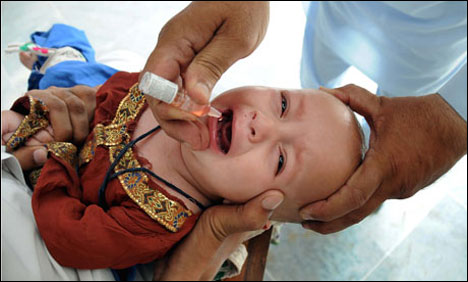
Fighting against polio in Manghopir at her own risk

Standard

a baby being administered the life saving anti-polio drop

a baby being administered the life saving anti-polio drop

Karachi

In Manghopir, the health centre is heavily guarded. A Rangers mobile stands at the gate. Uniformed soldiers stand in position; their overused AK-47s pointing at the main road ahead.

For the past few months, the centre has been used for two more purposes: a Rangers’ headquarters; and the residence of Farzana Baloch – a vocal woman who has been a part of local vaccination campaigns for the past 17 years. She heads a union council in Manghopir, a Taliban hotbed now.

In what was originally a simple job to provide healthcare at every doorstep, she and her family of six has been forced to leave her home and seek refuge in a few rooms at the centre, under the hawk-eyed guard of the paramilitary soldiers.

The problem? Delivering anti-polio vaccines in post-Osama Bin Laden world.

After reports emerge that the American intelligence agency used a fake hepatitis vaccination campaign to hunt down the Al-Qaeda chief, polio vaccination drive in Pakistan has suffered a major setback in Pakhtun-dominated localities.

Manghopir’s Sultanabad is no different.

Propaganda

“After the Mehsud Taliban took over entire neighbourhoods, it has been next to impossible for us to vaccinate the children against polio,” says Baloch, sitting in her sparsely furnished office at the health centre. “When we go to their houses, they invite us in for a cup of tea, and state that they just can’t get their children vaccinated against the polio virus.”

“Many of these families come to the centre later to get their children vaccinated against hepatitis and malaria, which are not part of the government’s door-to-door service, but take special care that the polio vaccine is not administered to them.”

The reason is propaganda from the pulpit and the pamphlets distributed, terming the polio vaccine a ploy by the West to render the Muslim world infertile.

“Why is the vaccination drive conducted only in Muslim countries?” are some of the questions Baloch has to answer frequently.

But recently there have been cases where mothers have quietly given anti-polio drops to their children when their husbands are not at home.

“The change has come through repeated advertisements run on the state television,” Baloch believes. “These Pakhtun families do not get cable television but rely on the good, old PTV for news and entertainment.”

She remembers how after Shakeel Afridi, the doctor who staged the CIA’s vaccination drive, was arrested by the law enforcers posters of Shahid Afridi, the famous cricketer working as a goodwill ambassador for international aid agencies, had to be torn off from the centre. “Both of them were ‘Afridis‘, and we were scared of a possible backlash,” says Baloch.

Intimidating presence

She has seen the worst days in the profession—days when she did not know if she would get home alive.

“Last year, young men from the Mehsud Taliban faction would sit in a neat row just outside my office. They never said anything but their presence was intimidating,” she said. “I asked all my workers not to talk to them, or confront them.”

There were times when she received threatening phone calls. “Stop what you are doing” the callers would say.

But she is happy with the change in her residence. “It’s safe here. And now my workers go in the field with the Rangers and police officials. They are not scared for their lives.”

“But when we enter a neighbourhood with the law enforcers, locals eye us with suspicion. They feel that we act as their spies.”

They have reason to do so. Often as soon as polio campaigns end, the paramilitary force launches a search operation. They pick up young boys and take them away for interrogation.

“For instance after we ended a campaign on July 5, the paramilitary conducted an operation the very next day,” says Baloch.

 More work

With the military operation in full swing in North Waziristan, she admits families of internally displaced persons, who have never been vaccinated, have begun arriving. This might mean added work for Baloch and her team.

“Sometimes I feel the vaccination drive is a never-ending hole which keeps on getting deeper. The polio vaccine is just an excuse. The actual fight is between the state and the people, who have taken up arms against it. Whenever the state decides the right way to tackle with this faction, polio would automatically become history.”

Her words make sense.

*her picture has not been published for security reasons

originally published here