Fighting against polio in Manghopir at her own risk

Standard

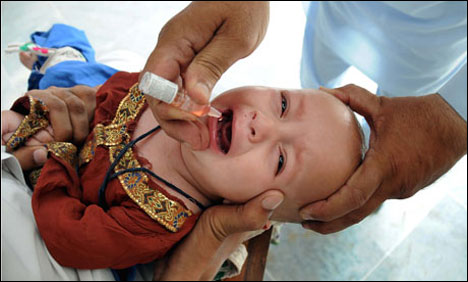
a baby being administered the life saving anti-polio drop

a baby being administered the life saving anti-polio drop

Karachi

In Manghopir, the health centre is heavily guarded. A Rangers mobile stands at the gate. Uniformed soldiers stand in position; their overused AK-47s pointing at the main road ahead.

For the past few months, the centre has been used for two more purposes: a Rangers’ headquarters; and the residence of Farzana Baloch – a vocal woman who has been a part of local vaccination campaigns for the past 17 years. She heads a union council in Manghopir, a Taliban hotbed now.

In what was originally a simple job to provide healthcare at every doorstep, she and her family of six has been forced to leave her home and seek refuge in a few rooms at the centre, under the hawk-eyed guard of the paramilitary soldiers.

The problem? Delivering anti-polio vaccines in post-Osama Bin Laden world.

After reports emerge that the American intelligence agency used a fake hepatitis vaccination campaign to hunt down the Al-Qaeda chief, polio vaccination drive in Pakistan has suffered a major setback in Pakhtun-dominated localities.

Manghopir’s Sultanabad is no different.

Propaganda

“After the Mehsud Taliban took over entire neighbourhoods, it has been next to impossible for us to vaccinate the children against polio,” says Baloch, sitting in her sparsely furnished office at the health centre. “When we go to their houses, they invite us in for a cup of tea, and state that they just can’t get their children vaccinated against the polio virus.”

“Many of these families come to the centre later to get their children vaccinated against hepatitis and malaria, which are not part of the government’s door-to-door service, but take special care that the polio vaccine is not administered to them.”

The reason is propaganda from the pulpit and the pamphlets distributed, terming the polio vaccine a ploy by the West to render the Muslim world infertile.

“Why is the vaccination drive conducted only in Muslim countries?” are some of the questions Baloch has to answer frequently.

But recently there have been cases where mothers have quietly given anti-polio drops to their children when their husbands are not at home.

“The change has come through repeated advertisements run on the state television,” Baloch believes. “These Pakhtun families do not get cable television but rely on the good, old PTV for news and entertainment.”

She remembers how after Shakeel Afridi, the doctor who staged the CIA’s vaccination drive, was arrested by the law enforcers posters of Shahid Afridi, the famous cricketer working as a goodwill ambassador for international aid agencies, had to be torn off from the centre. “Both of them were ‘Afridis‘, and we were scared of a possible backlash,” says Baloch.

Intimidating presence

She has seen the worst days in the profession—days when she did not know if she would get home alive.

“Last year, young men from the Mehsud Taliban faction would sit in a neat row just outside my office. They never said anything but their presence was intimidating,” she said. “I asked all my workers not to talk to them, or confront them.”

There were times when she received threatening phone calls. “Stop what you are doing” the callers would say.

But she is happy with the change in her residence. “It’s safe here. And now my workers go in the field with the Rangers and police officials. They are not scared for their lives.”

“But when we enter a neighbourhood with the law enforcers, locals eye us with suspicion. They feel that we act as their spies.”

They have reason to do so. Often as soon as polio campaigns end, the paramilitary force launches a search operation. They pick up young boys and take them away for interrogation.

“For instance after we ended a campaign on July 5, the paramilitary conducted an operation the very next day,” says Baloch.

 More work

With the military operation in full swing in North Waziristan, she admits families of internally displaced persons, who have never been vaccinated, have begun arriving. This might mean added work for Baloch and her team.

“Sometimes I feel the vaccination drive is a never-ending hole which keeps on getting deeper. The polio vaccine is just an excuse. The actual fight is between the state and the people, who have taken up arms against it. Whenever the state decides the right way to tackle with this faction, polio would automatically become history.”

Her words make sense.

*her picture has not been published for security reasons

originally published here 
 

In Machar Colony, knights in scrubs have come from far away

Standard

images

Karachi

This is a story of a few good doctors who left their comfortable European lifestyle to aid suffering humanity in Karachi’s impoverished slum of Machar Colony.

In the process, they learnt to adapt – shed their western clothes for a modest shalwar kameez and headscarf, bear the intolerable May heat, and eat roti and spicy lentils for lunch.

Situated next to the Lyari Station on a service road off Mauripur Road, a clinic has been quietly, but efficiently, providing primary healthcare to the residents of the squatter settlement for over a year now.

The white single-storey unimposing structure in its first year delivered 498 babies, held 5,833 health sessions and treated 14,816 patients at its emergency room.

For the people living in Machar Colony where a preventable disease like measles claimed several lives last year, this is good news. For pregnant mothers, it is their only access to quality healthcare.

Inside the spotless labour room, Shamshad Begum has just given birth to her seventh child – a beautiful baby girl.

“It’s a girl again. I have five girls. Two of my children died. Because I wanted a boy so much, my sister gave me one of her sons to take care of,” she says lying on a hospital bed, surprisingly cheerful for a woman who has just given birth.

A nurse instructs her to use birth control. “I will have to ask her father,” says Shamshad pointing at her newly-born baby.

Her doctor, Katrina Nelson, does not understand a word of Urdu. It has been only a month since she arrived in Karachi. Originally from Denmark, when she signed up for the Doctors without Borders (MSF), an international not-for-profit organisation which works extensively in Asia, Africa and South America, she knew she would be travelling all around the world.

So how has the city been treating her? “It’s exciting work. Women have many more child complications in this part of the world. Many of the women we receive here are extremely anaemic,” she says.

“It’s not that they don’t know that they should rest or take breaks while having babies. But the fact is that their living conditions don’t let them take care of themselves or make decisions when it comes to childbearing.”

Marlies Degroote, a doctor from Belgium, heads the vaccination programme at the clinic. She has just returned from a long meeting planning the measles vaccination drive that will start in a few days. Dressed in a blue shalwar kameez and beige dupatta wrapped over her head, Degroote can pass for a Pakhtun woman.

“Last year we could only cover 29 percent of the population in Machar Colony for our vaccination drive against measles. Several children died last year. This year, we plan to vaccinate 69,000 children,” she says.

The colour of their skin was something that none of the locals at the squatter settlement liked. They viewed the doctors with suspicion – foreigners there to spy on them, take their pictures and sell them to America or worse, instil western ideals into their women.

“Every time you begin working in a locality, people view you with suspicion. They feel that we are intruders. It’s only natural. That’s why we need to play safe. The reason for our low vaccination coverage last year was precisely this,” says Degroote.

This year the team is prepared. They have talked to the community leaders and clerics and visited schools, madrassahs and mosques. Now they feel that the community trusts them.

They will go out in the field for vaccination without any security guards. Display of weapon or even carrying one is against their policy.

“That’s why you don’t see a security guard at our gate. We believe if the community understands that you are there to help, they will not attack.”

There was time when the clinic began receiving extortion threats from various crime gangs operating in the locality. The workers at the clinic say that the doctors invited the extortionists to the table to talk. “When they understood that the doctors did not charge patients for treatment, they apologised and never troubled us again,” says Mona Korejo, a health promotion supervisor.

So that the MSF does not become a tool for spy agencies of the world to collect information, it runs only through private donations.

Degroote excuses herself. Ruth and the others are waiting for lunch. She is hungry, “and the daal roti we just ordered is getting cold”.

originally published here