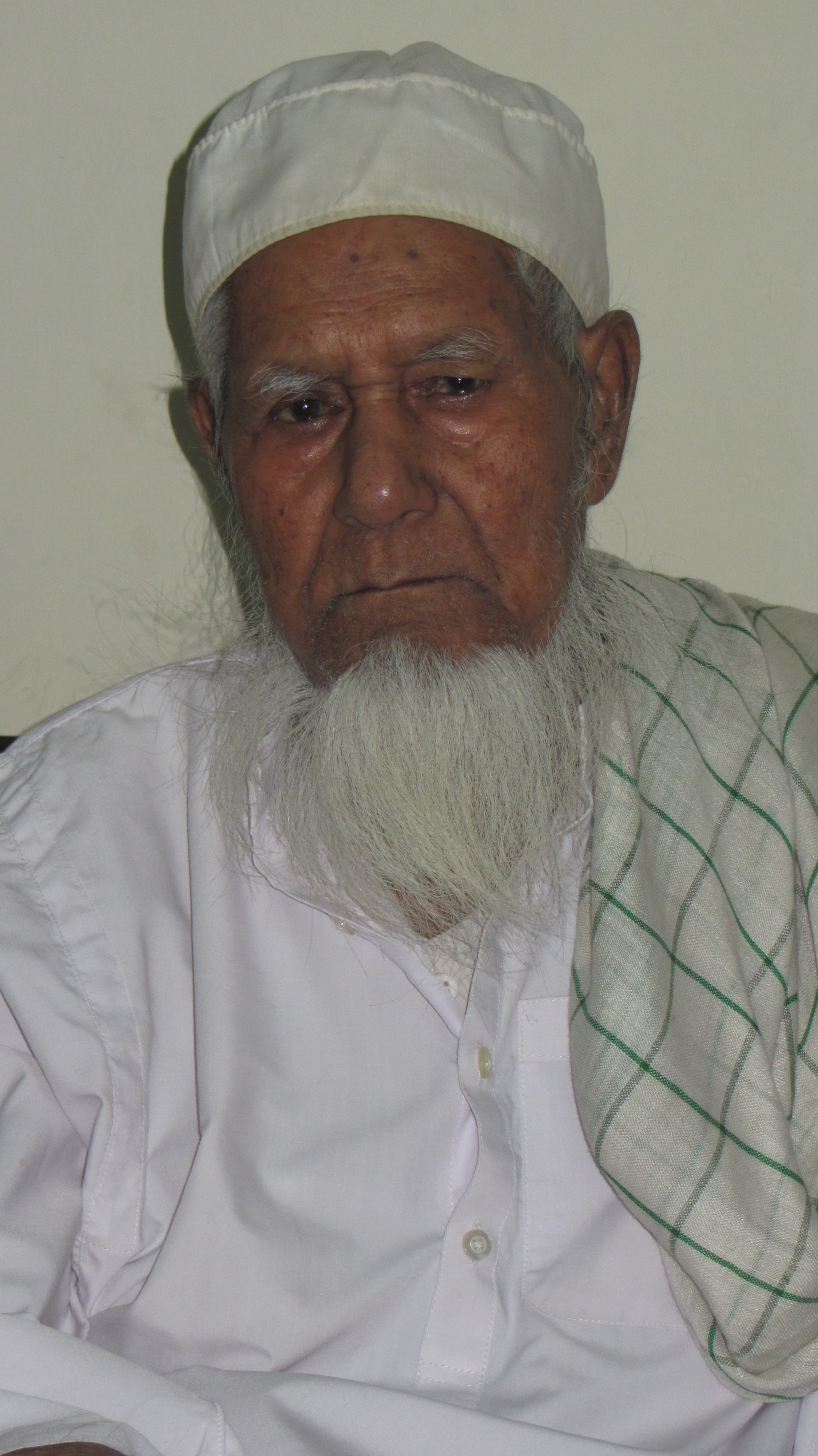
In Orangi, a 100-year-old diehard fan of two Quaids

Standard

Karachil

IMG_2549

by Sidrah Roghay

Karachi

A few months short of his 100th birthday, Aseeruddin Ahmed, makes a fraction of the 0.225 percent of Pakistani voters, who have lived for more than 91 years.

Clad in a white kurta and a chequered dhoti, he holds in his right hand a walking stick, which, when it does not support his frail body, is used to hit anyone who speaks against Mohammad Ali Jinnah or Altaf Hussain – the two Quaids he refuses to hear ill of.

“Till my last breath,” he vows, “I will vote for the Muttahida Qaumi Movement.”

Such is his loyalty toward the party that he still remembers the number plate of Hussain’s motorcycle (KAJ-161), on which the MQM chief came to Orangi Town.

“Bhai would sit on the floor with us and hold meetings,” Ahmed recalls. “Those were the good days, filled with hope.”

In his neighbourhood, where he has lived most of his life, people lovingly call him Chacha. And though he cannot walk around the streets anymore, his grandsons also find it impossible to move around with him in a car because passersby keep stopping them, to invite their beloved Chacha for a cup of tea.

Till the last elections in 2008, his health allowed him to walk door to door in Orangi Town to motivate the people to come out and vote but wisely “for the person who gave you your identity” he would hint.

He struggles to remember the infamous Operation Cleanup against the MQM in the 90s that forced many of the party leaders to escape but then drifts off to the days before partition.

An employee at the British Railways, Ahmed was 35 at the time of Partition. “I remember filling a form, writing I am a Muslim and in favour of Pakistan,” he recalls.

Back then, he lived in Saidpur, where the largest railway workshop for Assam-Bengal province was established by the British. After Partition, Saidpur came under East Pakistan – now Bangladesh. Ahmed remembers the massive bloodshed forced the Hindus to flee to the Indian border while the Muslims migrated to the other side of the border. “But there was hope. We were ready to sacrifice everything for the homeland our leaders had carved out for us.”

Not yet had the emotions of living in a Muslim homeland fizzled away, when there was the second partition, as Bangladesh broke away from Pakistan.

Every now and then, Chacha brings up a town called Munger in his conversation. His son explains Munger was mainly an Urdu-speaking town of Bihar, India. When Bangladesh was created, the Urdu-speaking community there fled to West Pakistan fearing for their lives in communal violence.

Ahmed became a migrant for the second time. He landed in Quetta. Much later, in 1974, he arrived in Karachi and made it his permanent residence. But if there is anything that he winds up after all his struggles, it is the fact that he had lost two homes. “We were two nations before Partition based on the two-nation theory. Then we became three when Bangladesh was carved out. Now four or five nations inhabit Pakistan. There will be more partitions,” Ahmed warns.

http://www.thenews.com.pk/Todays-News-4-175419-In-Orangi-a-100-year-old-diehard-fan-of-two-Quaids
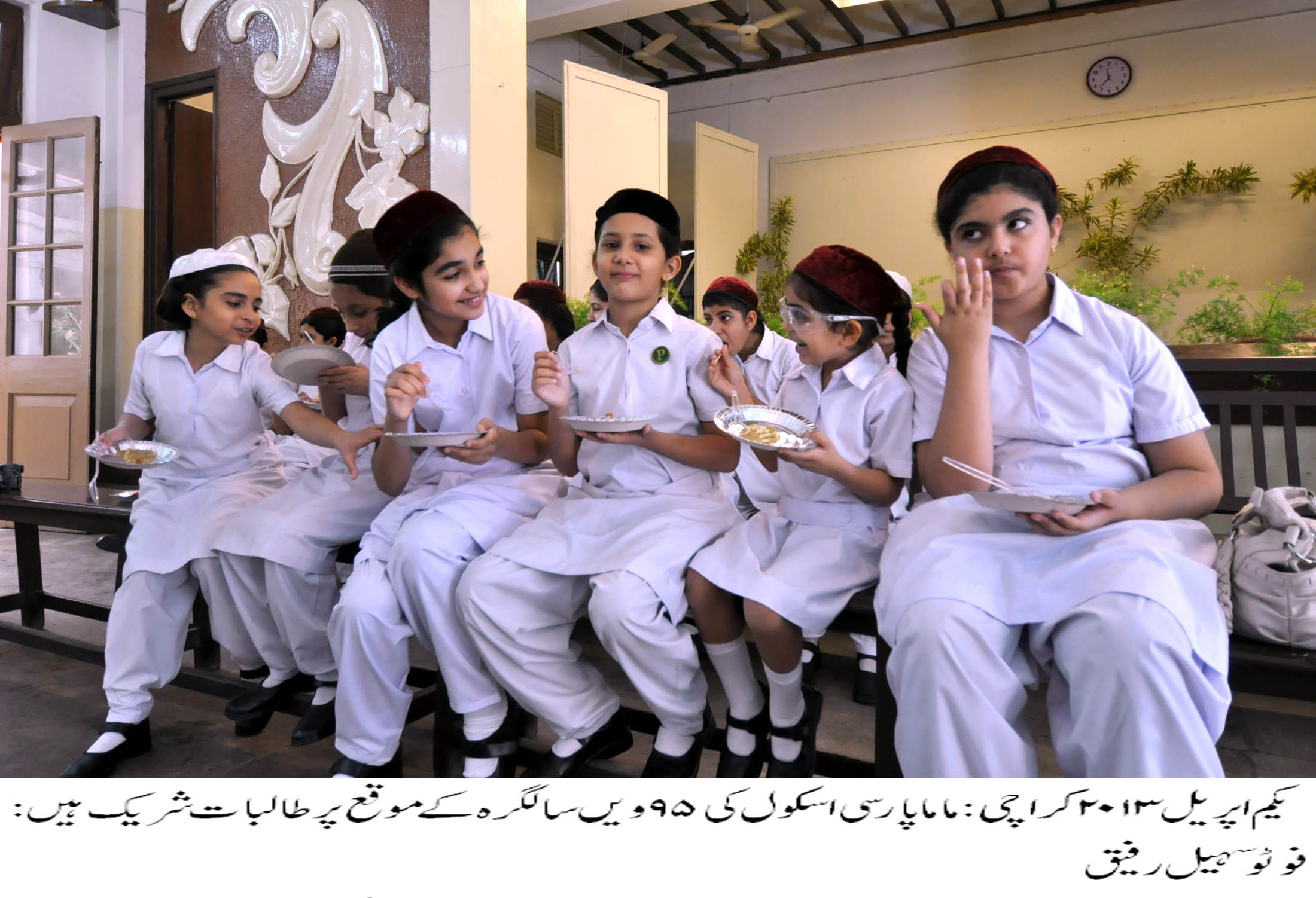
Churning out Mamaians for 95 years, and still going strong

Standard

Karachi

suhail rafiq


People build institutions and then it is the other way around. The Mama Parsi Girls’ School, which turned 95 on Monday, has earned a reputation for building several thousand lives.

The classrooms of the 18th century sandstone building has nurtured the likes of Ferishtay Aslam, the head of corporate affairs Unilever; Nabeela, the hairstylist; and Sameera Raja, the sole proprietor of the Canvas Gallery.

In its corridors, students of all social classes have walked hand in hand dressed in the same uniforms – right down to their hairbands and socks.That was one “eccentricity” that Mrs Shigri, who has served the school for 33 years, noted on her first day there.

“The girls looked exactly the same. Even their hairbands were the same colour: black, plain plastic.”Over the years she saw the school grow. “An O-level section opened. Last year, we became affiliated with the Aga Khan University Examination Board.”

The school works in two shifts – morning and afternoon – and educates about 2,127 girls.It is not that the journey has been easy. A teacher recalls how politicians pressured the school to admit their children. “A famous politician belonging to the city’s largest party once forced former principal Zarin T Mavalvala to give admission to his daughters. When she refused, the school began receiving excessive electricity bills, but Mavalvala did not succumb to the pressure,” she said.

A former teacher of the school claims that there were times when the Board of Secondary Education Karachi refused to give Mamaians positions despite them scoring the highest marks.

“They [the BSEK officials] used to demand a certain amount of money. But Mavalvala refused. She said, ‘I don’t want the position; I want my girls to be good human beings’,” the teacher disclosed requesting anonymity. That was one of the reasons Mama Parsi shifted to the AKU-EB.

Mavalvala, an old Parsi lady in a skirt, refuses to comment. She smiles: “The time to comment has gone, and the time to act has begun. We need good teachers; we have enough schools.”

 Jashan and Milad

To celebrate its 95th anniversary, a Jashan prayer was organised for Parsi girls and a Milad for Muslim girls.

The doorways of the school were decorated with garlands of yellow carnations, patterns of white chalk filled with red, yellow and blue powder designed on the floor.

“It brings good luck. In every Parsi home you will find it, unless there has been a death,” explained Dolly Trompaymala, who takes care of the school decoration.

Inside the prayer room, a row of 20 Parsi girls sat on a bench wearing prayer caps. Next to them was a larger group – teachers with heads covered with scarves. Two priests sitting on a white mantle lighted a fire and offered prayers.

The rest of the girls – more than 2,000 – left for the ground where the Milad was organised. They took off their socks, placed them in plastic bags they were asked to bring, and sat on a white chaddar. Girls sitting on a stage in colourful dupattas began the Milad.

They spoke eloquent Urdu, and delivered poetic verses praising the Holy Prophet (PBUH). Five girls stood up, and sprayed rose water on the audience.

Nine-year-old Haya watched all the proceedings from a distance. Unlike the other students who sat on the floor, she was in a chair. Her legs turned inwards at an awkward angle. Haya is disabled, but that does not put a full stop to her mental growth.

“I want to be a science teacher when I grow up, and teach at the Mama Parsi,” she hopes.

Non-teaching staff

Schools would not be the same if it were not for the janitors, peons and maids.Sixty-year-old Nasreen has swept the mosaic floors of the huge school building since she was a young girl. Ex-Mamaians recall how the corridors echoed with the tinkle of her anklets back then.

Now an older woman dressed in a saree, she smiles, joy shining through her eyes. But she is too shy to comment.Nasreen lives in the backyard of the building, where many other employees reside.

History

On April 1, 1918, the Parsi community established a school for their girls. They had a boys’ school – the BVS Parsi School – founded in 1870. As there was not a separate school for girls, the founding fathers of the Mama Parsi School decided to open one.

Initially, the classes for girls started at the BVS Parsi School, but after a year, the girls’ school shifted to the Mama Mansion opposite Zainab Market.The building is now known as the Haq Building. On April 1, 1925, the 70 girls-strong school was shifted to its present building on the MA Jinnah Road.

In 1947, the Quaid-e-Azam requested the school management to also admit Muslims. From that time onwards, the school has been educating girls of all faiths without any bias or prejudice.

original published at http://www.thenews.com.pk/Todays-News-4-168811-Churning-out-Mamaians-for-95-years-and-still-going-strong

Photo by Saeed Qureshi, The News