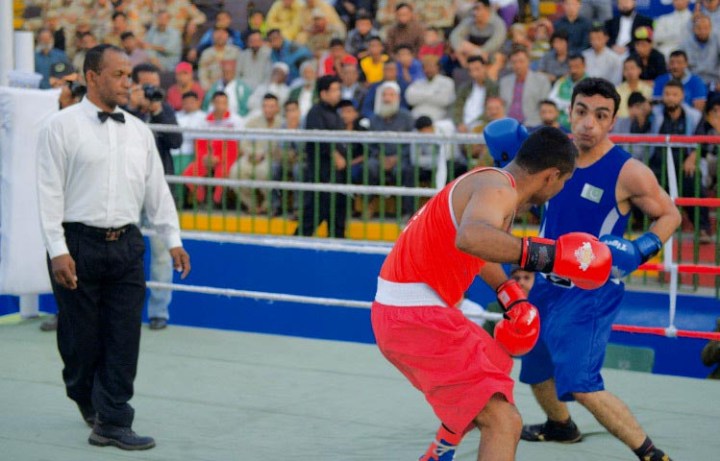
A round of boxing

Standard

Sidrah-amir-khan

There was a time, not long ago, when Lyari’s Mauripur Road would descent into silence after sunset, a silence that was only pierced by echoes of gunshots. Not anymore. For now, at least, the violent neighbourhood has abandoned street violence, and its youth are caught in a different kind of a battle — fought in a ring with boxing gloves on.

These days, Mauripur Road is a traffic warden’s nightmare, as giant trawlers to and from the Karachi port lazily move along the thoroughfare and fumes emanating from these diesel trucks choke the pedestrians and motorbike riders alike. Standing out in this chaos of ceaseless horns and headlights from vehicles stuck in the jam is Lyari Peoples Stadium — blazing with bright, multi-coloured, fancy lights.

A huge picture of British-Pakistani boxer Amir Khan dominates the entrance to the stadium. Pakistan Rangers — who have just cleared Lyari of itS gangs and helped establish some semblance of order in the lawless neighbourhood — is organising a boxing tournament, and the people are jubilant.

The Amir Khan Boxing Tournament, held from December 13 to 21, 2015 invited 16 teams from all over Pakistan. The winning team received a medal from the champion himself who visited Lyari for the final match.

Lyari has given Pakistan some of the best boxers, including Hussain Shah, who brought home the bronze medal in the 1988 Olympics.

Inside the Peoples Stadium the stage is all set. A young boxer in a gold embossed cloak enters the ring, as he waves his arms at the audience he imitates the world-class boxers he has seen on tv, and in response, the crowd roars with joy.

It is Team Red against Team Blue.

The crowd is all men. They back their teams with cheers in Balochi. They clearly haven’t had so much fun in a long time. Even the Rangers personnel crack up laughing with their rifles slung on their left arm.

“Boxing runs in the blood of Lyariites,” says Aqib Baloch, who is here to watch the match.

A statement released by the Rangers said, the tournament aims to promote a positive image of Lyari. It is part of the second phase of the operation where 2000 young Lyariites will be provided employment opportunities in the private sector and Sindh Rangers department.

He is right. Despite being notorious for gang wars, drugs and criminals, like Uzair Baloch, Lyari has had its share of aspiring boxers. Over 16 boxing clubs in the locality are training young boxers in the sport.

But over the years, the sport has somewhat lost its favour to more popular games, like cricket and hockey, and the government departments that patronised boxing teams have wrapped up their sports quota. The disappointed Lyari boxers that once starved for glory have resorted to drugs and gang wars.

Take Malang Baloch, a boxer who represented Pakistan in the 1972 Olympics. He would have been a national hero had he been a cricketer. But the old boxer lives in poverty and worries about making ends meets. His love for the sport is still alive and hopes that matches like these will help nurture young talent in Lyari. “There is peace in Lyari now. And a boxing tournament is taking place in the city after four long years.”

Nawab Ali, a boxing coach, claims that tournaments like these are a step in the right direction. “Talent hunts like these will revive interest in the sport. Very soon the government departments will relaunch boxing teams and our boys will get employment.”

Abid Hussain Brohi, Vice President Sindh Boxing Association, says: “Sports is the only way to bring peace back in Lyari”.

Elahi Bux, member of the Strengthening Participatory Organisation, a not-for-profit organisation, says: “The tournament has been organised by the Rangers which has been involved in scores of extrajudicial killings in the area. But to be honest this is not a bad initative”.

He adds, “Boxing has always been a poor man’s game. In Lyari it has always been a way for the unemployed youth to get a job on the sports quota with a government department. If such tournaments become a regular practice boxing might receive the boost it needs”.

A statement released by the Rangers said, the tournament aims to promote a positive image of Lyari. It is part of the second phase of the operation where 2000 young Lyariites will be provided employment opportunities in the private sector and Sindh Rangers department.

The winning team received Rs200,000 as cash prize and the runner-up received Rs150,000, while each participant received Rs5,000.

In the closing ceremony boxer Amir Khan reiterated his promise of establishing a boxing academy to nurture young talent in Lyari.

“I’m glad I’m in Lyari,” he said. “I’ll make the academy for all the boxers here. I have a fight in March and I hope everyone in Pakistan watches it. I’ll come back to Lyari after the fight.”

Meanwhile, Lyari will wait.

Originally published here

The many shades of Saad Aziz

Standard

By Sidrah Roghay

The President of Pakistan, Mamnoon Husain once walked the corridors at the Institute of Business Administration. So did Shaukat Aziz, former Prime Minister of the country, and Asad Umer, former Chief Executive Officer for Engro Companies.

So when only big names and success stories are attached to an educational institute, a terrorism suspect like Saad Aziz strikes shockwaves. And when the act of terrorism is as gruesome as shooting dead a bus full of unarmed Ismaili passengers, or pulling a trigger at an unsuspecting social activist like Sabeen Mahmud—it makes breaking news.

On May 20, at a press conference held by Sindh Chief Minister, Qaim Ali Shah, the names of four alleged terrorists were revealed. The police said that the suspects had confessed to killing social activist Sabeen Mahmud, murdering 45 Ismaili passengers on a bus, grenade attacks on several schools, the attack on an American professor Debra Lobo and aggression against members of the Bohri community.

One of the suspects was Aziz, who graduated from the IBA in 2011. Aziz stood out from the general profile of terrorists. He was not madrassa-educated.

Aziz had done his A Levels from the Lyceum. Before this he studied at the Beaconhouse School System. Born to an affluent family, Aziz lived in Gulshan-e-Iqbal, an upper-middle class locality. His father once worked for the Unilever as a director. He was married, had a child, and owned a profitable high-end restaurant called the Cactus at the Sindh Muslim Cooperative Society.

At the IBA

The general air at the IBA is that of extreme anger at the media. Aziz is innocent until proven guilty; and IBA did not have anything to do with the alleged terrorist.

“The media is being sensationalist. Bad journalism,” said Asma Zubair, a graduate of the IBA.

People who knew Aziz from IBA remember him as a gentle, polite person.

“I met him several times,” said his university colleague. “He was never overtly religious. A very amicable young fellow.”

A teacher who taught him remembered him as someone who did not talk a lot, “But when he asked questions, they were very good sensible questions.”

Dr Huma Baqai, a teacher at the IBA said, “He was a very hardworking child and passed with good grades.”

“It is troubling to know that terrorist thoughts and ideologies have also managed to affect youngsters with good education and decent parentage,” she said.

His close friends chose to keep their lips zipped. Many are angry at the media for probing too much. They believe Aziz is innocent.

Meanwhile, ever since his arrest his friend list on Facebook is reducing every day. People who learn about his alleged crimes are deleting him for fear of being contacted by investigation agencies.

Facebook display picture of Saad Aziz

His restaurant

The Cactus looks deserted, the waiters bored. It is a medium sized restaurant with bright lights and orange walls.

On its Facebook page with 60,000 likes, hate comments are pouring in.

“14 May Ismaili Killing Day”

“Unbelievable a restaurant and terrorism”

Qatil say gift mang rahe ho shame on you”

The Cactus situated at Sindh Muslim Cooperative Society, where many other cafes are, attracted a decent amount of customers.

It was once called the Kahva. But just before Aziz left IBA he was busy rebranding the family owned restaurant, his friends recall.

He had handed over the restaurant’s social media accounts to a digital media company. “He visited our office a few times to talk about the campaign,” said an employee at the company. “He seemed really nice. None of us can believe the news.”

The journey

The journey from a good student to an alleged terrorist is blurred. There are dots—vague gaps and lots of questions.

A newspaper report alleged that Aziz had become religiously inclined after attending various lectures at the IBA Iqra Society, a student group which organizes events where guest scholars speak about the Muslim way of life.

Many students scoffed at the allegation. “People at the Society are nice, moderately religious people,” said a student.

Another student added that the speakers never preached jihad or extremism.

But ideologies are not just preached through asking students to wage jihad. Take for example the profile of a speaker who addressed students at their Annual Islamic Conference this April.

Adnan Rashid, who calls himself a historian, has a staunch anti-West stance. Posts on his Facebook page denounces the West and blames it for all of the problems the Muslim world has faced. An avid follower of the scholar would come to the conclusion that the West and Muslims are stuck in an eternal clash.

This bifurcation between the West and Muslims, them and us, has been used by religious scholars and political parties to explain much of what is happening in the Muslim world. Simplistic views like the West being responsible for the problems of the Muslim world – these are the ideas that the Salafist thought is based upon.

When such speakers talk to impressionable minds, they are bound to develop a simplistic worldview which looks for the enemy in the West.

Aziz went to Waziristan twice for training. He was responsible for translating Urdu pamphlets into English. And he shot dead Sabeen Mahmud for her campaign against Lal Masjid, stated a report published in Dawn.

In a blog post which appeared in Express Tribune, Aziz’s friend from Lyceum said that as a teenager Aziz never had a close friend circle. “The more I think about it, the more I see how Saad was simply looking for a guiding hand throughout his A’levels, a bag hanging on his back….he remained on the periphery… The extremists may [have been] able to offer him something that our schooling system was unable to: a group of people where we felt valued, where we have purpose,” he wrote.

Amir Rana, director Pakistan Institute for Peace Studies, an Islamabad-based think tank said, “The presence of extremist tendencies in upper middle class and elite classes is not new, however in recent years their numbers have grown.”

Pointing at the growing number of ISIS militants from the West he said, “The Muslim diaspora in the West are familiar with these extremist tendencies.”

Daniel Pearl murderer Omar Saeed Sheikh, Al Qaeda IT expert Naeem Noor Khan, Al Qaeda operative Dr Arshad Waheed, Time Square bombing planner Faisal Shahzad, Danish embassy bombing culprit Hamad Adil, and the hijacker of a navy frigate at Karachi dockyard Owais Jakhrani are just few names, he said.

He added that Aziz belonged to a sleeper cell, “These groups can generate funds through criminal activity and because of their small size. They can sustain their activities on minimal resources.”

And he warned that this is not the only group active in Karachi.

– See more at: http://www.thefridaytimes.com/tft/the-many-shades-of-saad-aziz/#sthash.oBc8xGZ3.dpuf