In Orangi, terror looms over schools

Standard

Attacks and threats by criminal groups forcing students to drop out

Karachi

They had a simple dream: impart education to children in an underprivileged Pakhtun neighbourhood. That was in 1994, when the three friends Waheed, Latif and Amjad had graduated from the Karachi University.

Nineteen years later, Waheed has been murdered, Latif survived an assassination attempt but lost his leg, and Amjad has gone into hiding.
9545e07d-f925-44d4-b1ed-02e4b5e0e009

In Qasba Colony, where the friends lived, they taught children free of charge. Their passion helped them construct a school.

From a single room in 1994, it expanded into a large 20-room building where 800 students of the locality were taught in two shifts.

But this year, the Naunehal Academy, as the school was later named, has suffered consecutive setbacks, reducing the number of its student to a sorry 200.

In May, Waheed, its young, boisterous principal was shot dead. Following his death the school was shut down for a few months. Latif and Amjad relocated. So did, Waheed’s family: a widow, a 10-year-old son and a two-year-old daughter.

On August 15, it reopened amid threats. Three days later, when students were inside their classes, a home-made bomb exploded outside.

Two days passed on in peace, and then in the middle of the night the school was sprayed with bullets.

“The terrorists succeeded in spreading panic in the community. Scared for their lives, the students stopped coming to school,” said Latif, who has left Qasba Colony for a safer place.

“We also received an extortion slip for Rs500,000. It was signed by the Tehreek-e-Taliban Pakistan,” he added.

Some days ago, Latif had received a phone call. The caller had said, “We will tear down your house in Qasba if you don’t stop what you are doing.”

Latif said he told them to do whatever they wanted with his house. “It has been empty since Waheed’s death. People make a house… without people a house is worthless.”

The school is running amid security threats. During school hours, policemen in vans patrol the area. In addition, private security guards have also been hired. “They are costing us Rs40,000 every month.”

Amjad and Latif believe that the community, especially the militants in the area, have mistaken them for foreign agents.

They say it was partly because journalists, both from the local and foreign media, frequently visited the school.

But more importantly, the problem started after a polio centre was set up in the school in collaboration with the Rotary Club. “The CIA-funded hepatitis campaign to search for Osama bin Laden is often mistaken as a polio campaign in Pakhtun localities. Perhaps it was that very thing,” said Amjad.

But the plan is to gradually regain the community’s trust. Work only for education and not advocate for any controversial figures.

“It was education that we wanted to impart in our Pakhtun locality. We drifted from our focus,” lamented Amjad.

Latif said it was imperative that the children in the locality received education. “Because if books don’t answer their problems, eventually guns will.”

Growing threat

DSP Faisal Noor, who looks after Orangi Town, accepts there are growing incidents of violence against schools – extortionists to blame for many of the cases. “We can’t single out a single group because several criminals are hiding in this area.”

Schools are increasingly being targeted in Orangi Town. The list includes the Rakhshanda Public School, running for 25 years, which was hit by gunfire in September. The Nation Secondary School came under attack in March. Some men had entered the building on results’ day and opened fire, killing a student and the principal and injuring 12 others.

The Shaheen Public School has also been receiving threats from extortionists.
Churning out Mamaians for 95 years, and still going strong

Standard

Karachi

suhail rafiq


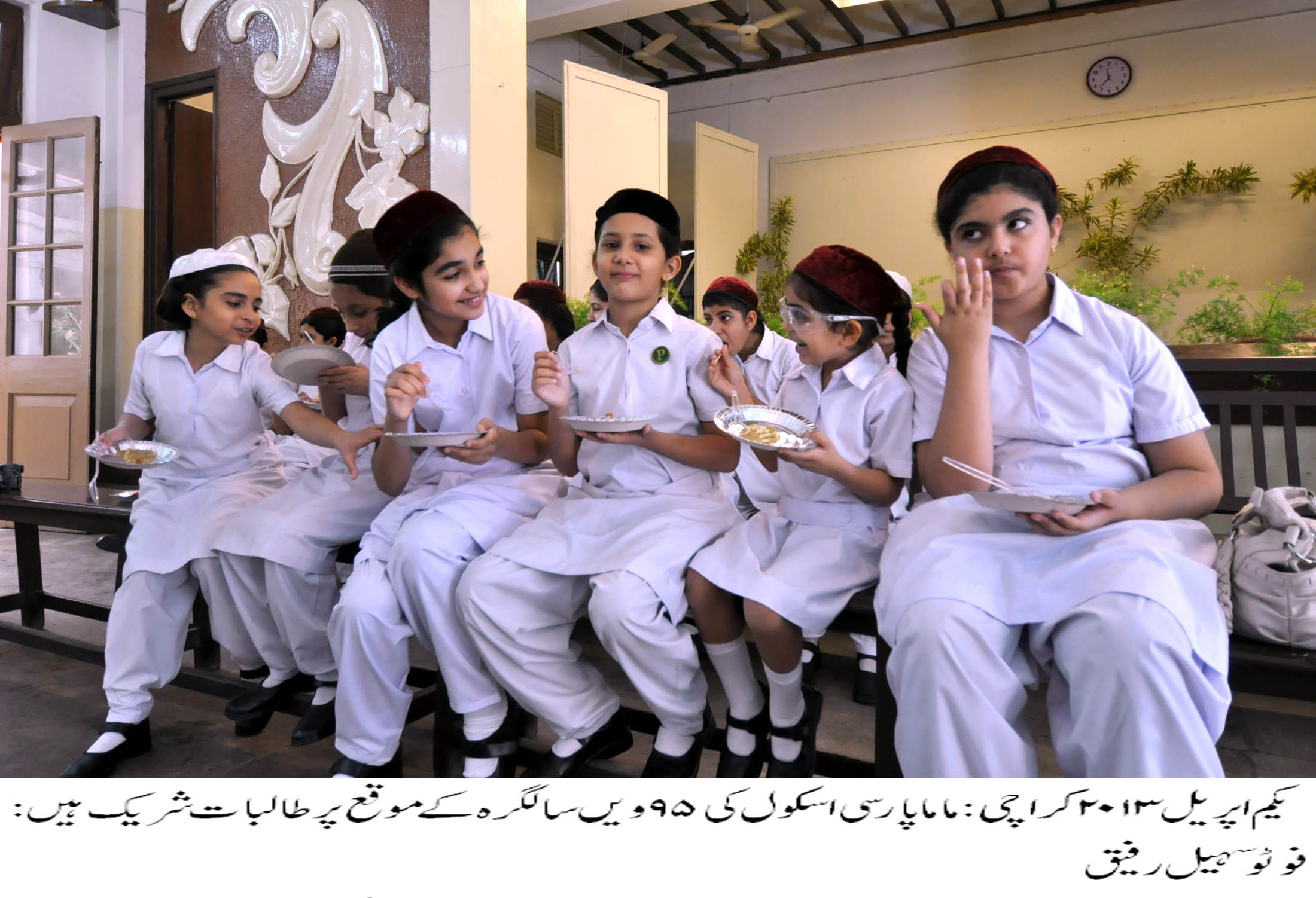
People build institutions and then it is the other way around. The Mama Parsi Girls’ School, which turned 95 on Monday, has earned a reputation for building several thousand lives.

The classrooms of the 18th century sandstone building has nurtured the likes of Ferishtay Aslam, the head of corporate affairs Unilever; Nabeela, the hairstylist; and Sameera Raja, the sole proprietor of the Canvas Gallery.

In its corridors, students of all social classes have walked hand in hand dressed in the same uniforms – right down to their hairbands and socks.That was one “eccentricity” that Mrs Shigri, who has served the school for 33 years, noted on her first day there.

“The girls looked exactly the same. Even their hairbands were the same colour: black, plain plastic.”Over the years she saw the school grow. “An O-level section opened. Last year, we became affiliated with the Aga Khan University Examination Board.”

The school works in two shifts – morning and afternoon – and educates about 2,127 girls.It is not that the journey has been easy. A teacher recalls how politicians pressured the school to admit their children. “A famous politician belonging to the city’s largest party once forced former principal Zarin T Mavalvala to give admission to his daughters. When she refused, the school began receiving excessive electricity bills, but Mavalvala did not succumb to the pressure,” she said.

A former teacher of the school claims that there were times when the Board of Secondary Education Karachi refused to give Mamaians positions despite them scoring the highest marks.

“They [the BSEK officials] used to demand a certain amount of money. But Mavalvala refused. She said, ‘I don’t want the position; I want my girls to be good human beings’,” the teacher disclosed requesting anonymity. That was one of the reasons Mama Parsi shifted to the AKU-EB.

Mavalvala, an old Parsi lady in a skirt, refuses to comment. She smiles: “The time to comment has gone, and the time to act has begun. We need good teachers; we have enough schools.”

 Jashan and Milad

To celebrate its 95th anniversary, a Jashan prayer was organised for Parsi girls and a Milad for Muslim girls.

The doorways of the school were decorated with garlands of yellow carnations, patterns of white chalk filled with red, yellow and blue powder designed on the floor.

“It brings good luck. In every Parsi home you will find it, unless there has been a death,” explained Dolly Trompaymala, who takes care of the school decoration.

Inside the prayer room, a row of 20 Parsi girls sat on a bench wearing prayer caps. Next to them was a larger group – teachers with heads covered with scarves. Two priests sitting on a white mantle lighted a fire and offered prayers.

The rest of the girls – more than 2,000 – left for the ground where the Milad was organised. They took off their socks, placed them in plastic bags they were asked to bring, and sat on a white chaddar. Girls sitting on a stage in colourful dupattas began the Milad.

They spoke eloquent Urdu, and delivered poetic verses praising the Holy Prophet (PBUH). Five girls stood up, and sprayed rose water on the audience.

Nine-year-old Haya watched all the proceedings from a distance. Unlike the other students who sat on the floor, she was in a chair. Her legs turned inwards at an awkward angle. Haya is disabled, but that does not put a full stop to her mental growth.

“I want to be a science teacher when I grow up, and teach at the Mama Parsi,” she hopes.

Non-teaching staff

Schools would not be the same if it were not for the janitors, peons and maids.Sixty-year-old Nasreen has swept the mosaic floors of the huge school building since she was a young girl. Ex-Mamaians recall how the corridors echoed with the tinkle of her anklets back then.

Now an older woman dressed in a saree, she smiles, joy shining through her eyes. But she is too shy to comment.Nasreen lives in the backyard of the building, where many other employees reside.

History

On April 1, 1918, the Parsi community established a school for their girls. They had a boys’ school – the BVS Parsi School – founded in 1870. As there was not a separate school for girls, the founding fathers of the Mama Parsi School decided to open one.

Initially, the classes for girls started at the BVS Parsi School, but after a year, the girls’ school shifted to the Mama Mansion opposite Zainab Market.The building is now known as the Haq Building. On April 1, 1925, the 70 girls-strong school was shifted to its present building on the MA Jinnah Road.

In 1947, the Quaid-e-Azam requested the school management to also admit Muslims. From that time onwards, the school has been educating girls of all faiths without any bias or prejudice.

original published at http://www.thenews.com.pk/Todays-News-4-168811-Churning-out-Mamaians-for-95-years-and-still-going-strong

Photo by Saeed Qureshi, The News