Faraz* was an employee at a textile factory in Karachi drawing Rs40,000 a month. Europe for him was a distant dream — a place with clean roads, rich people and no hardships, a heaven on earth.
The idea of traveling illegally to Europe was first introduced to him by Ali, a friend at work. “The stakes are high; there is no guarantee that we will make it alive but it’s worth a shot,” Ali had told him. Faraz agreed. Both of them resigned from their jobs in November last year.
As the European Union (EU) opened its doors for migrants from Syria and Iraq fleeing ISIS, thousands from developing countries like Pakistan, Bangladesh and Iran are also said to have flooded Europe. Most of these migrants in search for greener pastures were denied entry at the Greece-Macedonia border to be told that only conflict-hit migrants were welcome in the EU.
Protests emerging at this border were reported world-wide — mostly because of their uniqueness, which included sewing their lips together and stripping down all through December 2015.
Faraz, a father of two young children, recalls meeting an agent in Karachi North who briefed him about the journey. They were to travel to Gwadar from Karachi, board a boat to Iran, ride a bus to Turkey, get on a boat to reach Greece. And Europe thereafter was all his to explore.
Faraz paid the agent Rs100,000. He asked him to meet his mother, and tell her that he would be okay. Faraz knew better but wanted his mother to stay satisfied.
The agent had been honest, he says. “There are only 40 per cent chances you will make the journey alive. People die in the process.”
Whether it was the naivety of a 29-year-old young man or his spirit of adventure or the raw appeal of a glittering Europe he doesn’t know but Faraz agreed to take the risk.
On a cold December night, Faraz packed a few clothes, some dry fruit and cash in a small backpack. That was all he thought he would need to make “the journey of his life”. He was placed on a Datsun pickup truck which was to take him to Gwadar. “That truck could accommodate 12 passengers. We were 30 grownup men packed at the back”. Faraz made the most uncomfortable eight-hour journey of his life that night — or so he thought then. “My knees were held to my chest, my elbows fixed to my sides”.
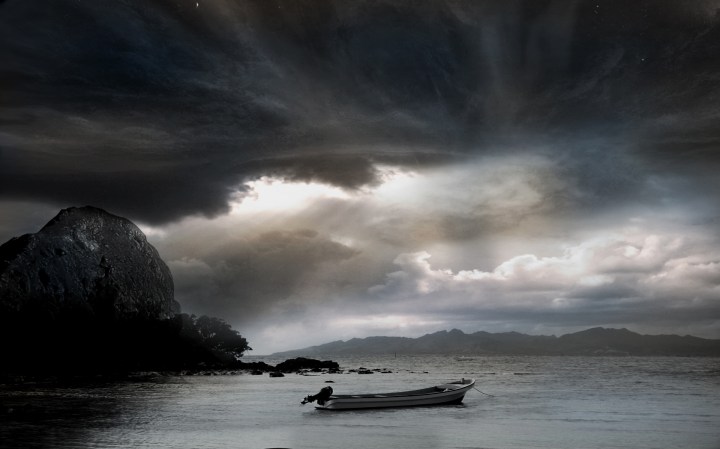
Once at Gwadar, the group rested at a shack by the sea. They were to make another journey to Iran — this time by the sea. “At about 1am, an agent woke us up. We were packed inside a locally manufactured motor boat — an engine attached to a small wooden boat. The boat could hold ten people at a time. We were no less than 50”.
The passengers had to stay very quiet or else the border security would hear them. They couldn’t move because even a slight movement would make the boat lose its balance. “The sea is a terrible place. Our small boat rocked with the waves. It would go up as high as a three storey building — and then come crashing down”.
Some of the passengers started throwing up. Others screamed. An agent who could only speak Farsi told them to shut up. Two of the passengers began screaming for help. “The agent threw them off the boat into the sea”.
There was silence in the boat as the passengers struggled to register the fact that two of them had just perished in the sea. The boat reached Juhi, a small village by the sea in Khuzestan Province of Iran. “We were given stale bread to eat and some yogurt, and asked to wait for a car that would pick us up.”
The car came to pick them at 12.30am. They were taken to Bander Abbas, Iran’s busiest port city, and were left at a place that Faraz described as “a jungle”. They waited for three days in the open. There was nothing to eat, and Faraz survived on the nuts he had packed in his bag. They relieved themselves in the bushes — and “some even drank their own urine for there was no water”.
“The mosquitoes there were as big as houseflies. There were snakes. One of our companions got bitten by a snake. Foam started coming out of his mouth and he died instantly,” recalls Faraz. “Gradually we realised we had become animals. We hid our food. We fought for water”.
Three nights later, a man came to pick them up. They were huddled in the trunk of a Corolla 2D. “We were made to stand in a prostrated position, like you do during prayers, and that is how I covered the eight-hour journey to Tehran”.
Faraz remembers he couldn’t breathe or move. There were four or five people packed in the car — like suitcases, and he remembered they all stank after days of travel. He remembers travelling from one city to the other in Iran, and seeing “lots and lots of mountains”.
Somewhere in the middle he almost got shot to death.
“After we left Bandar Abbas, we reached a forest. We had to cross a mountain in the night, in the one hour that the Border Security Force changed shifts. There were wild bushes on one side, and date orchards on the other.
“Suddenly a search light shone on us. And then there was gunfire. I ran towards the date trees. Something hit me but I didn’t stop. I thought a bullet had hit my back. I ran for over an hour. And I prayed. I prayed to God not to let me die there, not in the cold, in a foreign country.”
When he stopped to rest, and took off his backpack, he saw that a bullet had pierced through it. The backpack was in pieces, but Faraz remained unscathed.
“There were 20 of us, all dispersed. We were lost in the wilderness in a foreign country,” he recalls.
Faraz spent another night in the open. And then an Iranian man he did not recognise came to fetch him. He took him to an agent and they made it to Tehran.
The next stop was Maku, an Iranian city situated 22 kilometres away from the Turkish border. From Maku, packed in a car, Faraz and his other companions left for Turkey in a fleet. Faraz was in a Sedan car; Ali, his friend from Karachi, was in a truck.
The truck cleared the border security check. But the Sedan was stopped. The security force asked Faraz to step out. They gave him a body check, and found a knife in his sock which he had kept for safety. Faraz was in trouble and so were all the people in the car. They were deported to Iran.
Faraz then remembered being transferred to several jails in Iran: Maku, Tehran, Zahidan, and then he finally crossed over into Quetta, where he took a bus back to Karachi.
Faraz came home, tired, shaken, questioning his existence. “If only I could have crossed Turkey, I would have been in Europe”.
He had home-cooked food after a month. He rested, and slept on and off. And then he got a call from Ali. Ali had made it to Europe.
“He lived in a camp at Turkey, did odd jobs, could not save enough to send back home. Having seen Turkey, he realised Europe was not just glitter and gold. He handed himself over to the police, who put him on a plane back home.”
Though there are no exact figures of how many people like Faraz travelled illegally to Europe this year, the Washington Post puts it at tens of thousands, although Syrians and Afghans make a bulk of those seeking asylum.
Would Faraz make the whole journey again if someone guarantees to take him to Europe. “If he gives me one hundred per cent guarantee, I think I will,” he says, adding his wife would try her best to stop him.
*Names have been changed to protect the identities.


 sidrahroghay