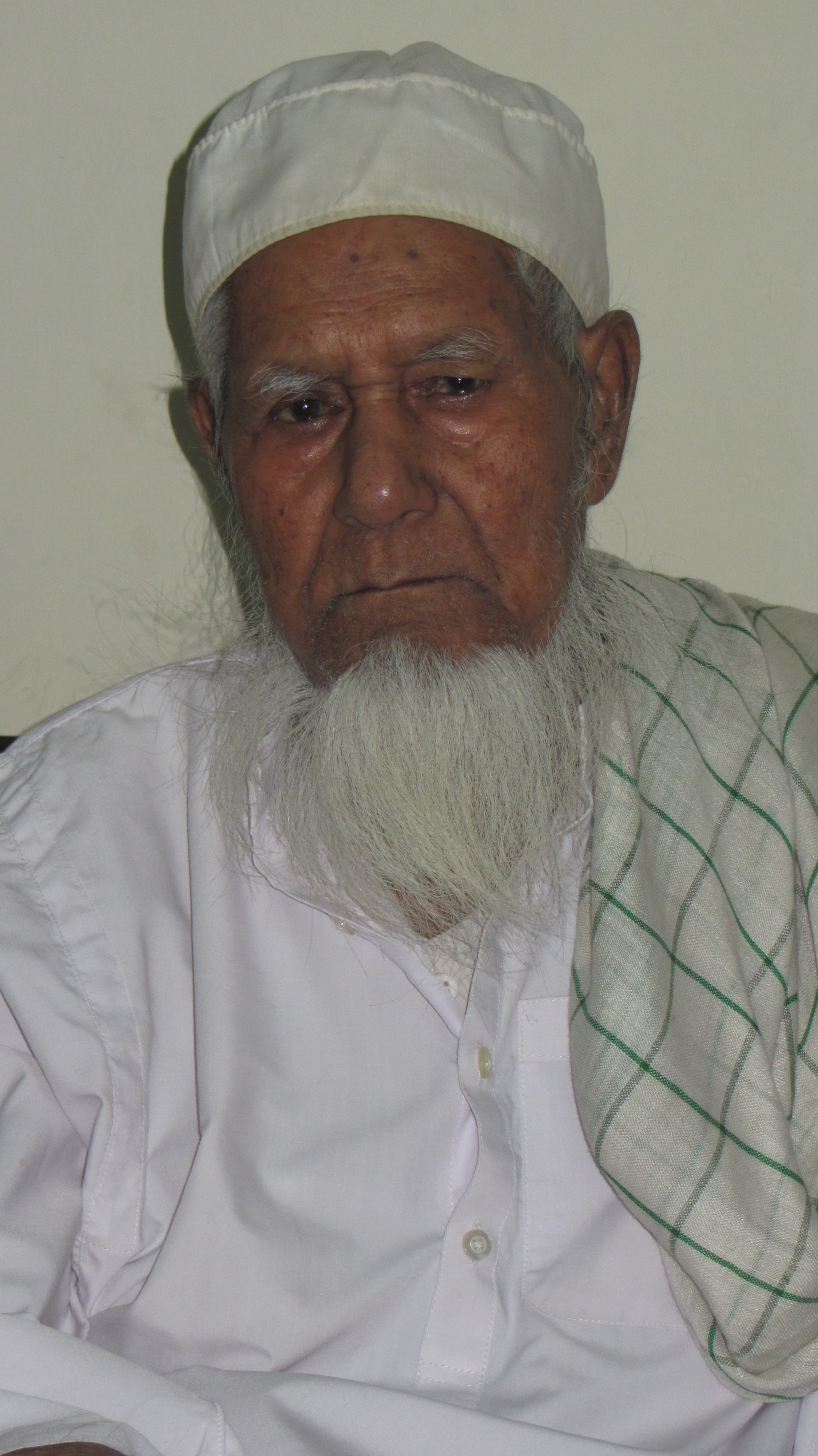
In Orangi, a 100-year-old diehard fan of two Quaids

Standard

Karachil

IMG_2549

by Sidrah Roghay

Karachi

A few months short of his 100th birthday, Aseeruddin Ahmed, makes a fraction of the 0.225 percent of Pakistani voters, who have lived for more than 91 years.

Clad in a white kurta and a chequered dhoti, he holds in his right hand a walking stick, which, when it does not support his frail body, is used to hit anyone who speaks against Mohammad Ali Jinnah or Altaf Hussain – the two Quaids he refuses to hear ill of.

“Till my last breath,” he vows, “I will vote for the Muttahida Qaumi Movement.”

Such is his loyalty toward the party that he still remembers the number plate of Hussain’s motorcycle (KAJ-161), on which the MQM chief came to Orangi Town.

“Bhai would sit on the floor with us and hold meetings,” Ahmed recalls. “Those were the good days, filled with hope.”

In his neighbourhood, where he has lived most of his life, people lovingly call him Chacha. And though he cannot walk around the streets anymore, his grandsons also find it impossible to move around with him in a car because passersby keep stopping them, to invite their beloved Chacha for a cup of tea.

Till the last elections in 2008, his health allowed him to walk door to door in Orangi Town to motivate the people to come out and vote but wisely “for the person who gave you your identity” he would hint.

He struggles to remember the infamous Operation Cleanup against the MQM in the 90s that forced many of the party leaders to escape but then drifts off to the days before partition.

An employee at the British Railways, Ahmed was 35 at the time of Partition. “I remember filling a form, writing I am a Muslim and in favour of Pakistan,” he recalls.

Back then, he lived in Saidpur, where the largest railway workshop for Assam-Bengal province was established by the British. After Partition, Saidpur came under East Pakistan – now Bangladesh. Ahmed remembers the massive bloodshed forced the Hindus to flee to the Indian border while the Muslims migrated to the other side of the border. “But there was hope. We were ready to sacrifice everything for the homeland our leaders had carved out for us.”

Not yet had the emotions of living in a Muslim homeland fizzled away, when there was the second partition, as Bangladesh broke away from Pakistan.

Every now and then, Chacha brings up a town called Munger in his conversation. His son explains Munger was mainly an Urdu-speaking town of Bihar, India. When Bangladesh was created, the Urdu-speaking community there fled to West Pakistan fearing for their lives in communal violence.

Ahmed became a migrant for the second time. He landed in Quetta. Much later, in 1974, he arrived in Karachi and made it his permanent residence. But if there is anything that he winds up after all his struggles, it is the fact that he had lost two homes. “We were two nations before Partition based on the two-nation theory. Then we became three when Bangladesh was carved out. Now four or five nations inhabit Pakistan. There will be more partitions,” Ahmed warns.

http://www.thenews.com.pk/Todays-News-4-175419-In-Orangi-a-100-year-old-diehard-fan-of-two-Quaids

A town where parents think twice before sending kids out

Standard

Karachi

What’s worse: finding your missing child’s mutilated body or never finding him at all? For parents living in Mobina Town, Gulshan-e-Iqbal sending their children out has become a nightmare.

Six-year-old Saqib went missing from the neighbourhood on April 7. He went to the market and never returned. His body was found from the bushes, raped and tortured.

At the funeral, his mother could only manage to say: “I have only one child left.” Saqib’s 10-year old sister, visibly angry, screams out words too mature for her age. “Why did they do this to my brother? Get me the culprit, I will cut him into pieces and feed him to the dogs,” she cries.

Women at the funeral say the little boy’s neck had been ripped open due to strangulation.

At some distance, sits another woman, weeping uncontrollably. Her four-year-old daughter, Nisha, went missing three years ago, never to be found. Saqib and Nisha were cousins. “My son came back. I can see his dead body. I can mourn for him,” wails Saqib’s mother. “But what about her? She lives in constant fear,” she points at the crying woman.

None of Nisha’s sisters go to school. They stay in the house all day. “I cannot lose another child,” says their mother.

Nothing new

Missing children are not a new occurrence in Mobina Town. This year alone, five children have already gone missing from the neighbourhood. Three of them turned up dead. Two were never found.

“A paedophile is on the loose in the area. He’s a serial killer. He follows a pattern,” claims one man, who lives in the area.

Last year, a similar case was also reported in Scout Colony, adjacent to Mobina Town. Five-year-old Faiza went to a shop in the neighbourhood and was kidnapped on February 26. A day later, the tortured and raped girl was found dead in Gulzar-e-Hijri.

At the police station

A suspect was caught two days after Saqib’s episode. Police claimed he owned a small shop in the area and had another accomplice, who has not been arrested to date.

“The man admitted during interrogation that he did it for pleasure,” says Faisal Qureshi, a police officer. “The suspect is aged between 25 and 26 years. He lives in the neighbourhood and ran a pakora stall. He admitted kidnapping Saqib and raping him at a ground.”

Later, the man got scared the child will tell others so he strangled him to death and threw his body at a plot in Metroville. Police claim Saqib’s murder is slightly different than others as the killer was less brutal. “Generally such bodies are severely tortured. One girl had her heart gouged out,” a policeman says.

Zafar Iqbal, the Gulshan-e-Iqbal police superintendent, denies more than one case has been reported in Mobina Town. “We only found one body this year and the suspect is under trial.”

The civil society

Muhammad Ali, the head of Roshni Helpline, claims Mobina Town is a “red-zone” to kill and dump bodies of children.

His social welfare organisation, which works on missing children, has recorded three such cases in Gulshan-e-Iqbal this year, out of which one body was recovered. Last year, 10 children went missing in the town. Eight turned up dead.

Madadgar National Helpline chief Zia Awan also expresses serious concerns over the rapid increase in cases of kidnapping and killing children after subjecting them to sexual abuse.

According to the organisation, over 190 children – 128 boys and 74 girls – have gone missing from Karachi from January to March this year. Most of these cases have been reported from the police limits of Mobina Town, Sachal Goth, Mehmoodabad and Sharea Faisal, he says.

Mobina Town and Sachal Goth are located behind the University of Karachi. Usually minors of poor families fall prey to the criminals while playing outside their homes. A child gone missing is not a criminal offence in itself. A police station will not register a case or investigate the issue unless the parent or guardian suspects the child may have been kidnapped.

Roshni Helpline chief Ali, however, terms this “a mere wordplay”. “Most parents are so disturbed when a child goes missing they forget stating their child may have been kidnapped,” he says. “The police use this to their advantage and place the child name in the ‘roznamacha’, where entries for lost things like identity cards and mobile phones are made.”

http://www.thenews.com.pk/Todays-News-4-172555-A-town-where-parents-think-twice-before-sending-kids-out