Karachi
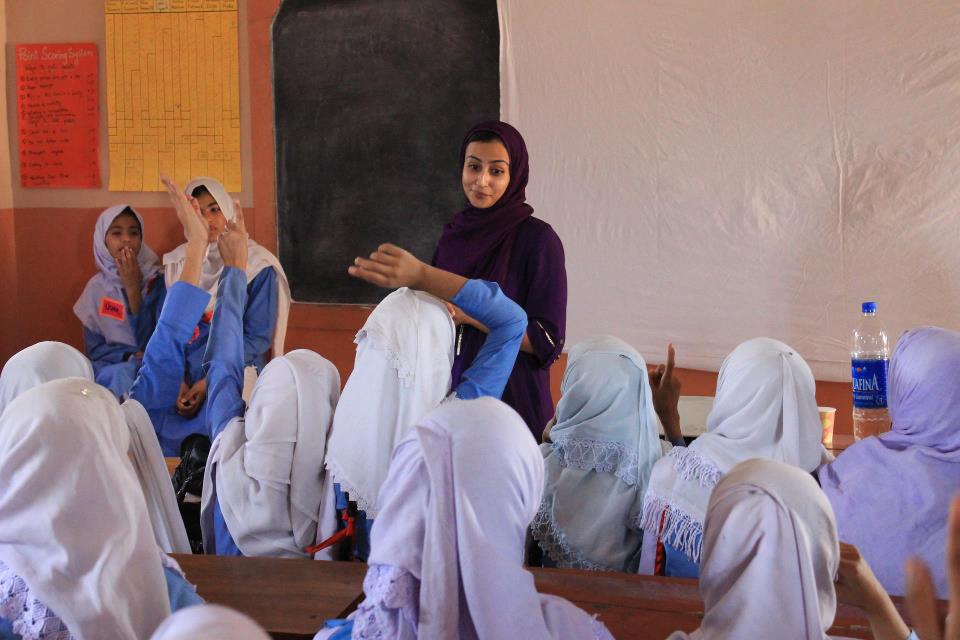
After a not-for-profit organisation adopted the Government Girls Secondary School Intelligence in Sultanabad, its students began to dream big: of flying airplanes, becoming lawyers and working as journalists. To put it in the words of one young student: “I want a degree in law so that I can fight for my rights. Meanwhile, I will write for newspapers.”
These ambitions had been missing in the largely Pakhtun student body that came from conservative backgrounds. But two years after the adoption, it was not just the building structure that improved but also the attitude of the students, who decided that education was their right and the only way out.
The latest fad in education is public-private partnership. If private individuals step up to assist the government in improving education, the country will quickly achieve its Millennium Development Goal of achieving universal primary education by the year 2015.
Sounds good. But here’s an unsettling fact: 16 years after the Sindh Education Department introduced its adopt-a-school policy – which encouraged the private sector to parent orphaned public schools – a meagre 280 of the 47,557 public schools in the province have been adopted.
That accounts for less than 0.6 percent – a sorry figure in a province where every seventh school is non-functional.
Numbers say a lot. And in this case it is clear that the adopt-a-school policy has had no far-reaching impacts: either it is not allowing private individuals to do much, or it is a partnership where the government refuses to contribute.
“Individuals or organisations that adopt schools are caregivers for the schools. They do not own it but can take steps to improve the quality of education,” said Maria Ijaz of the Sindh Education Foundation, the government body that deals with all school adoptions in the province.
“The adopters can hire their own teachers. But they cannot fire existing teachers. They have to generate their own funds, as the government does not provide them with any monetary help.”
So is this a partnership where the adopters have to suffer? Or is this an attempt by the state to abdicate its responsibility and dump it on the private sector?
Is it a gesture through which the government makes its clear that it cannot do anything about the 29 percent out-of-school children in Sindh?
Mosharraf Zaidi, director of education advocacy programme Alif Ailaan, criticised public-private partnership in education.
“It is complete abdication of responsibility by the state. You cannot expect the private sector, whose main aim is to earn profit, to work for the welfare of the people.”
He has a point. No matter how hard the private sector tries to provide education to children who cannot afford to pay for it, its efforts will always be a drop in the ocean.
Take for example The Citizens Foundation (TCF), undoubtedly the best model Pakistan has had in the not-for-profit sector. It took them 18 years to establish 1,000 schools all over the country.
“But no matter how hard we try, we cannot replace the government. We don’t have the kind of resources the government has. At best we can provide the government with a successful model it can follow,” Ahsan Saleem, one of the TCF founders, had said at an education conference held in Islamabad.
Then there is Sabina Khatri, known for the Kiran School in Lyari, who has now adopted a government school in Ibrahim Hyderi, a fishing village in the outskirts of Karachi.
“The policy makes it clear that the adopter cannot fire a government schoolteacher. So, even if the teacher is not performing or showing the will to improve, the adopter cannot fire him. I can hire another teacher against him, paying him from my own pocket. But what happens to the public money that is being wasted on idle government teachers?” she said.
“The private teacher I hire will listen to me because I pay her salary. The government teacher does not have a reason to listen to me, as I am not responsible for her appraisal.”
Sadiqa Salahuddin, president of the Indus Resource Centre and member of the committee that oversees adoption of schools, said: “Every year we receive a long list of willing adopters and we allow only a few to adopt. Adoption has its problems: the government cannot allow too many schools to be adopted because then it will also have to screen all of those schools. At the end of the day, it is the responsibility of the state and not private individuals to educate citizens.”
For the time being, students at the Government Girls Secondary School Intelligence in Sultanabad can dream big. But until the state learns from successful adoptions – such as the one of their school – and replicates them on a massive level, their children and grandchildren may not be as lucky.
originally published here

 sidrahroghay